
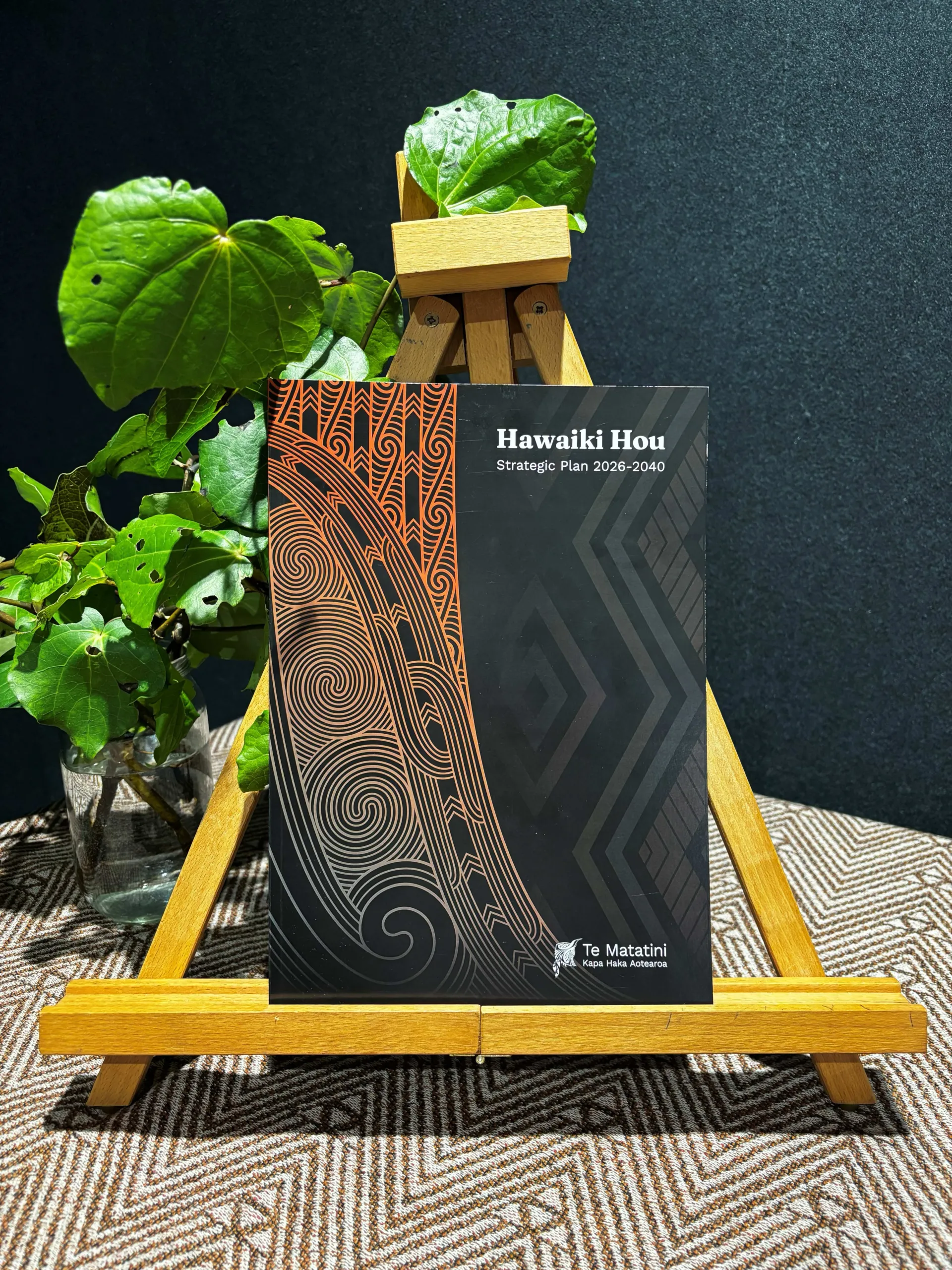

Te Matatini has officially presented its long-term vision for the future of kapa haka with the release of its new strategic plan, Hawaiki Hou (2026–2040).
The new strategy replaces the previous plan, Te Pītau Whakarei, a full year ahead of schedule due to early completion of all measurable outputs. The transition sets a course toward 2040, marking the bicentenary of Te Tiriti o Waitangi.
“It is with great pride that I present Hawaiki Hou – the new strategic plan for Te Matatini that will guide us towards achieving our vision of Mana Motuhake ki Te Kāinga. Matatū, Mataora, Matatini ki Te Ao by 2040,” says Tā Selwyn Parata, Te Matatini National Board Chair.
“We have successfully delivered on all measurable outputs in Te Pītau Whakarei 2017 – 2027, earlier than expected, and will transition seamlessly to Hawaiki Hou due to the strong foundation built over the past nine years,” Tā Selwyn added. “Looking toward 2040, the bicentenary of Te Tiriti o Waitangi, we have an opportunity to further elevate the contribution kapa haka makes to our people and our nation.”
Chief Executive Carl Ross highlighted the strong position of Te Matatini as it moves into this new strategic chapter.
“Te Pītau Whakarei, our 10-year strategy, has guided us through a remarkable period of growth, steered us through challenging waters and brought us closer to our long-term vision,” says Mr. Ross. “We are in a position of strength as we transition to Hawaiki Hou and the new chapter in our journey.”
Te Matatini continues to serve as an economic and cultural engine for Aotearoa. The Te Matatini o Te Kāhui Maunga National Kapa Haka Festival 2025 injected nearly $24 million into the local economy while expanding cultural understanding across attendees.
To build on this impact, Hawaiki Hou focuses on six key strategic priorities:
• Strengthening our 13 rohe
• Building pathways for whānau
• Improving financial sustainability
• Measuring impact
• Expanding global connections
• Delivering excellent events
“Hawaiki Hou challenges us to be bold, work together, seek opportunities and be innovative as we consider how kapa haka can grow its reach and economic value while remaining firmly grounded in Māori values, leadership and aspirations,” Mr. Ross stated. “While the horizon before us is ambitious, the foundation has been laid, and the lessons of the past provide guidance for the future as we look towards 2040.”