


For a century, the New Zealand Māori Arts and Crafts Institute has preserved traditional Māori art forms, passing down the skills and knowledge of generations of master carvers and artists.
The institute is marking its centenary with the unveiling of a new waharoa, or entrance gateway, at Te Puia in Rotorua. Illuminated at the unveiling, the structure celebrates the institute’s legacy and welcomes visitors and students for the next 100 years.
Kaiwhakairo Albert Te Pou carved the new entrance, drawing inspiration from the institute’s identity and the different tribal styles represented in its carvings.
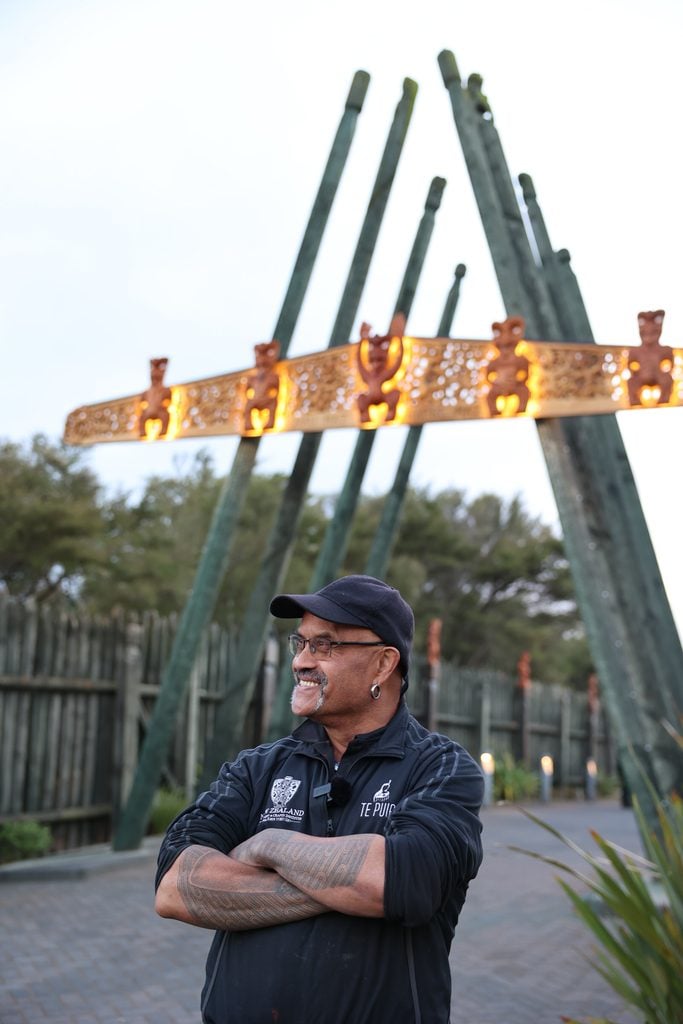

“This is the New Zealand Arts & Crafts and there’s nothing to show that, and the Manaia figure standing between the carvings are different tribal styles. So that’s where the inspiration came from, my thinking came from,” Te Pou said.
The institute’s origins date back to 1926, when Sir Apirana Ngata helped establish its school following the Māori Arts and Crafts Act.
NZMACI representative Eraia Kiel says the institute holds an important role in protecting Māori knowledge while inspiring future generations.
“We as Te Arawa are fortunate because we act as guardians of this treasure for the entire nation. This is not just a place of learning for Te Arawa alone, no, it is a place of learning that encourages and inspires all young people,” Kiel said.
Waiariki MP Rawiri Waititi acknowledged the elders who helped establish the kaupapa during difficult times, including Hone Taiapa, Sir Apirana Ngata and Heremiha Te Kapua.

Waititi says the institute’s work must continue to grow, with opportunities to extend its reach to iwi and hapū throughout the country.
Rotorua MP Todd McClay also recognised the institute’s contribution to Māori arts and crafts and said the centenary was a moment for the community to celebrate.

As part of the celebrations, each pillar of the new waharoa represents a school incorporated into the institute, acknowledging its growth, development and the expertise of its people.
Kiel says the challenge ahead is to embrace new opportunities while remaining grounded in tradition.
“Me tupu tēnei kaupapa me whanake a Te Puia toro atu ōna ringa ki te ao ki ngā mahi auaha, engari kia mau tonu ōna aka.”
As the institute looks to the future, the illuminated waharoa stands as a symbol of its enduring commitment to keeping Māori arts and cultural knowledge alive for generations to come.